Why Does My Dog Keep Destroying Their Bed?
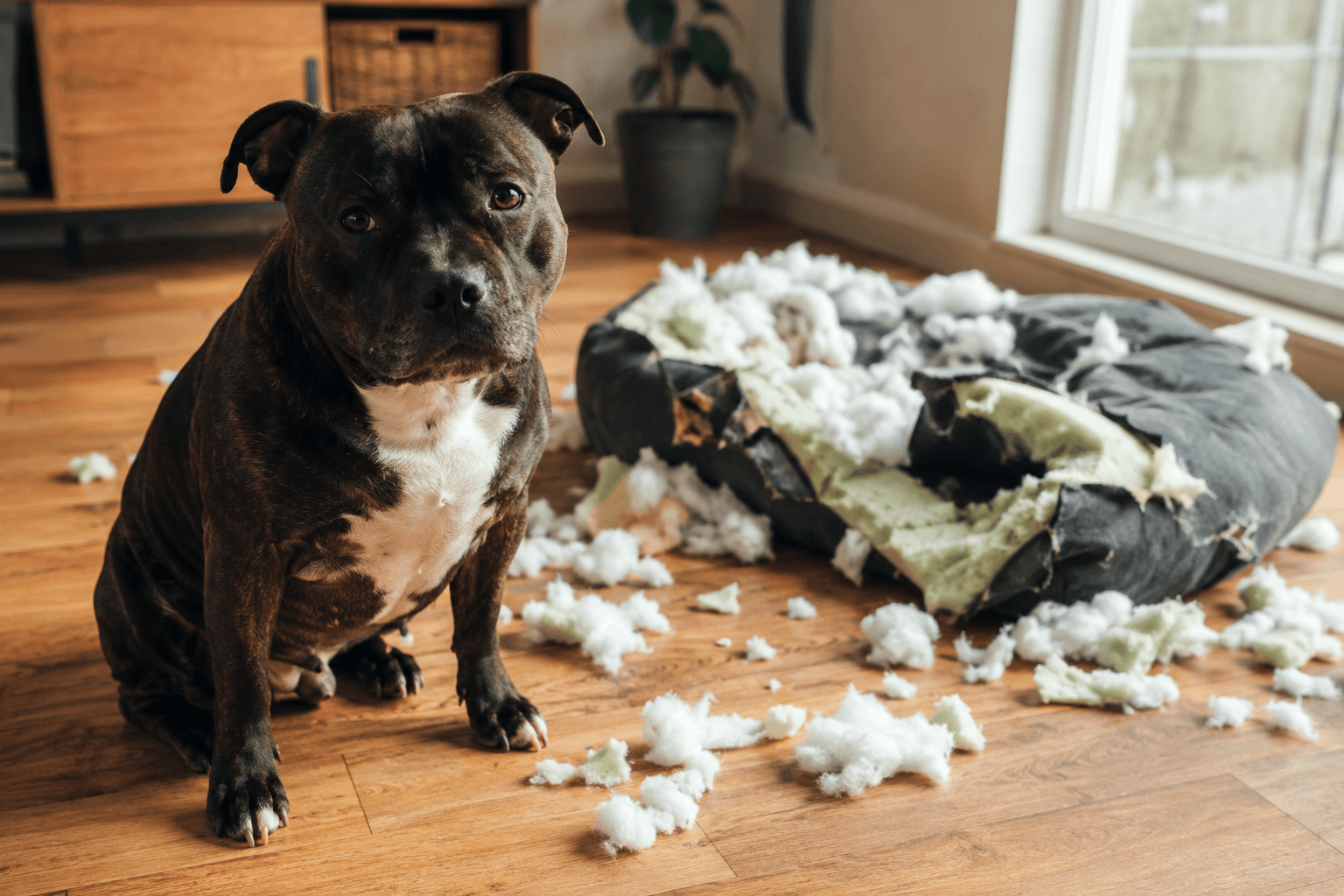
Your dog isn’t doing it to spite you. Here’s what’s actually going on — and what you can do about it.
You bought the bed. Maybe it wasn’t cheap. You set it up, your dog seemed to like it — and then, within days or weeks, it’s in pieces across the floor. Foam everywhere. Fabric shredded. You’re standing there wondering what you did wrong.
The first thing worth knowing: you probably didn’t do anything wrong, and neither did your dog. Destructive chewing is a normal behaviour with identifiable causes. Understanding those causes is both more useful and more honest than just buying a tougher bed and hoping for the best.
This article covers the main reasons dogs destroy their beds, how to tell which one applies to your dog, and what actually helps.
Chewing is normal. Destruction is a symptom.
Dogs chew. It’s not a flaw or a behavioural problem on its own — it’s a biological drive that serves multiple purposes: jaw exercise, stress relief, exploration, and stimulation. The problem isn’t that your dog chews. The problem is that the bed keeps ending up as the target.
When a dog destroys a bed repeatedly, it’s usually a signal that something in their environment, routine, or emotional state isn’t quite right. Punishment doesn’t address that underlying cause — which is why dogs who are punished for bed destruction typically go right back to it the moment they’re unsettled again.
To actually change the behaviour, you need to identify which of the following is driving it.
The four main reasons dogs destroy their beds
1. Boredom and unspent energy

This is the most common cause, and also the most straightforward to address. A dog with too much energy and not enough to do will create their own entertainment — and beds are soft, destructible, and easy to access.
Boredom-driven chewing tends to follow a pattern: it happens when the dog is left alone for long periods, is under-exercised, or isn’t getting enough mental stimulation. It’s often indiscriminate — the dog chews the bed, then the shoes, then the corner of the couch.
Working and herding breeds are particularly prone to this. Australian Kelpies, Border Collies, German Shepherds and Belgian Malinois were bred to be active and purposeful for most of the day. A single morning walk doesn’t come close to meeting their needs. When that energy has nowhere to go, it goes somewhere — usually somewhere you’d rather it didn’t.
How to tell if this is your dog: The destruction happens when they’ve been alone or inactive for a while. It’s often scattered — not focused on one spot. Your dog is generally high-energy and settles poorly indoors.
2. Separation anxiety

Separation anxiety is a more serious and specific issue than boredom. Dogs with genuine separation anxiety aren’t just restless — they’re distressed. They experience real stress when left alone, and chewing becomes a coping mechanism to regulate that emotional state.
Beds are a particularly common target for anxious dogs for an interesting reason: they carry strong scent associations. The bed smells like the owner and like the dog’s own resting space. Chewing something scent-rich is self-soothing. It temporarily relieves the tension, which reinforces the behaviour — so next time the anxiety spikes, the dog goes straight back to the bed.
Over time this creates a cycle that gets harder to break. The behaviour becomes a conditioned response to the trigger of being left alone, rather than a deliberate choice the dog is making.
How to tell if this is your dog: The destruction happens specifically when you leave, usually within the first 30–60 minutes. Your dog may also pace, bark, or show distress signs at departure cues (like picking up your keys). They may seem overly relieved when you return. The chewing is focused and intense rather than casual.
True separation anxiety usually needs a structured behaviour modification plan rather than just management. A trainer experienced in anxiety-based behaviours, or a veterinary behaviourist, can help if the distress is severe.
3. Breed instinct and jaw drive
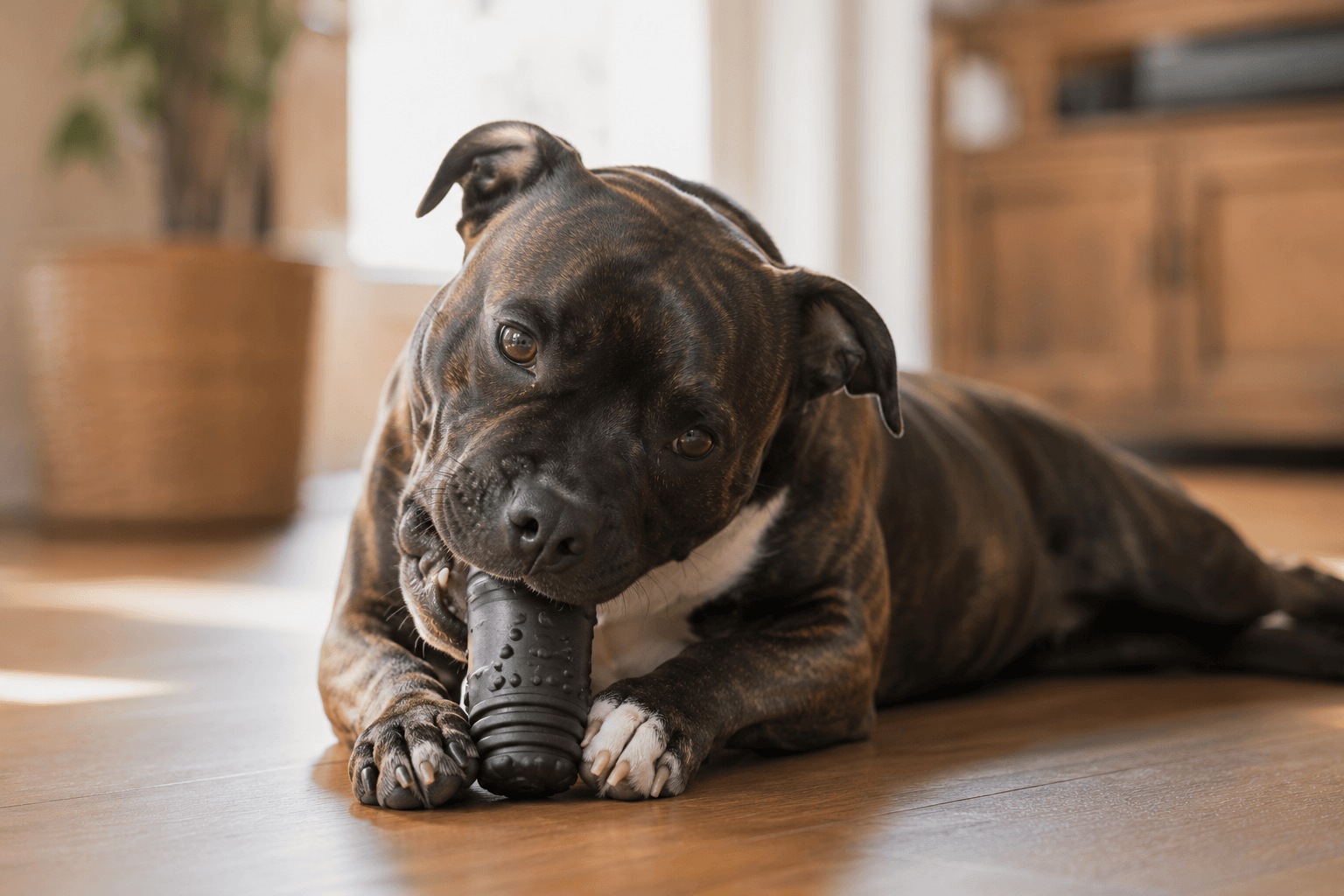
Some dogs chew a lot simply because they’re wired that way. Breeds developed for gripping, retrieving, hunting or protection work tend to have high jaw drive — a strong compulsion to use their mouths. This isn’t anxiety or boredom. It’s instinct operating as designed.
Staffordshire Bull Terriers are the most obvious example — powerful jaws, strong grip drive, and a breed history that includes working with their mouths. They’re not being destructive out of stress. They just genuinely enjoy chewing, and a soft foam bed is easy and satisfying to work through.
The same applies to Bull Arabs, Rottweilers, Labradors (retrieving breeds often carry things and chew constantly), Huskies, and many terrier crosses. These dogs may chew relatively calmly and contentedly, which is part of what makes it confusing — they’re not distressed, they’re just doing what comes naturally.
How to tell if this is your dog: They chew in a focused, methodical way — often settling in to work on one spot. They seem calm and engaged rather than frantic. The chewing happens regardless of whether they’ve been exercised. They also tend to chew toys, sticks, and other objects regularly.
4. Teething (puppies)

If you have a puppy under six months old destroying their bed, teething is almost certainly a factor. Puppies begin teething around three weeks of age and continue until their adult teeth are fully in, typically around six months. During this period the discomfort of incoming teeth is significant, and chewing provides relief.
Teething destruction is usually obvious — everything goes in the mouth, not just the bed. It also tends to reduce substantially once the adult teeth are through, which means waiting it out (with appropriate management and chew redirects) is a legitimate strategy for puppies who are otherwise well-adjusted.
That said, some dogs do form a chewing habit during the teething period that persists into adulthood because it’s been accidentally reinforced. If your older dog started chewing as a puppy and never stopped, they may have simply learned that beds are an acceptable chew object.
Why the bed specifically?
It’s worth asking why dogs so often target their bed rather than other objects. There are a few reasons:
- It’s always accessible. The bed is there 24 hours a day with no supervision. Other objects tend to be moved, stored, or guarded.
- It’s soft and destructible. Foam and fabric beds have similar physical properties to prey — they yield, they can be gripped and torn. A concrete floor doesn’t trigger the same response.
- It smells like the dog. The bed absorbs the dog’s own scent over time, which makes it a target for both anxious and instinct-driven chewers.
- Seams and edges are an invitation. Most beds have a clear starting point — a stitched edge, a zipper, a corner. Once a dog has worked through that weak point, the interior stuffing is easy and satisfying to pull out.
What actually helps
The right solution depends on the cause. Here’s what works for each:
For boredom and energy:
- More exercise, particularly high-intensity activity that actually drains energy rather than mild walks
- Mental enrichment — puzzle feeders, sniff work, training sessions — which tire dogs more efficiently than physical exercise alone
- Appropriate chew outlets (bully sticks, raw bones, durable chew toys) so the urge to chew has somewhere legitimate to go
- Supervising or restricting access to the bed until the habit is broken
For separation anxiety:
- Gradual desensitisation to departure cues and alone time — starting with very short absences and building up slowly
- Predictable daily routines, which reduce anxiety by making the dog’s day legible
- For severe cases: working with a trainer or veterinary behaviourist, who may also explore medical support
- Removing or replacing the bed so the conditioned trigger is disrupted while you work on the underlying anxiety
For breed instinct and jaw drive:
- Accept that this dog needs a chewing outlet and provide appropriate ones daily
- Train a “leave it” response so the dog understands the bed is off limits as a chew item
- Use a bed with no accessible weak points — no stuffing, no stitched seams, no zippers. An elevated PVC bed removes the things that make foam beds an attractive target.
For teething puppies:
- Provide appropriate cold chew items (frozen carrots, frozen Kongs, purpose-made teething toys)
- Don’t leave the puppy unsupervised with a foam bed — use a mat or towel instead until the teething phase passes
- Redirect consistently and reward calm interaction with the bed
Does the bed type make a difference?
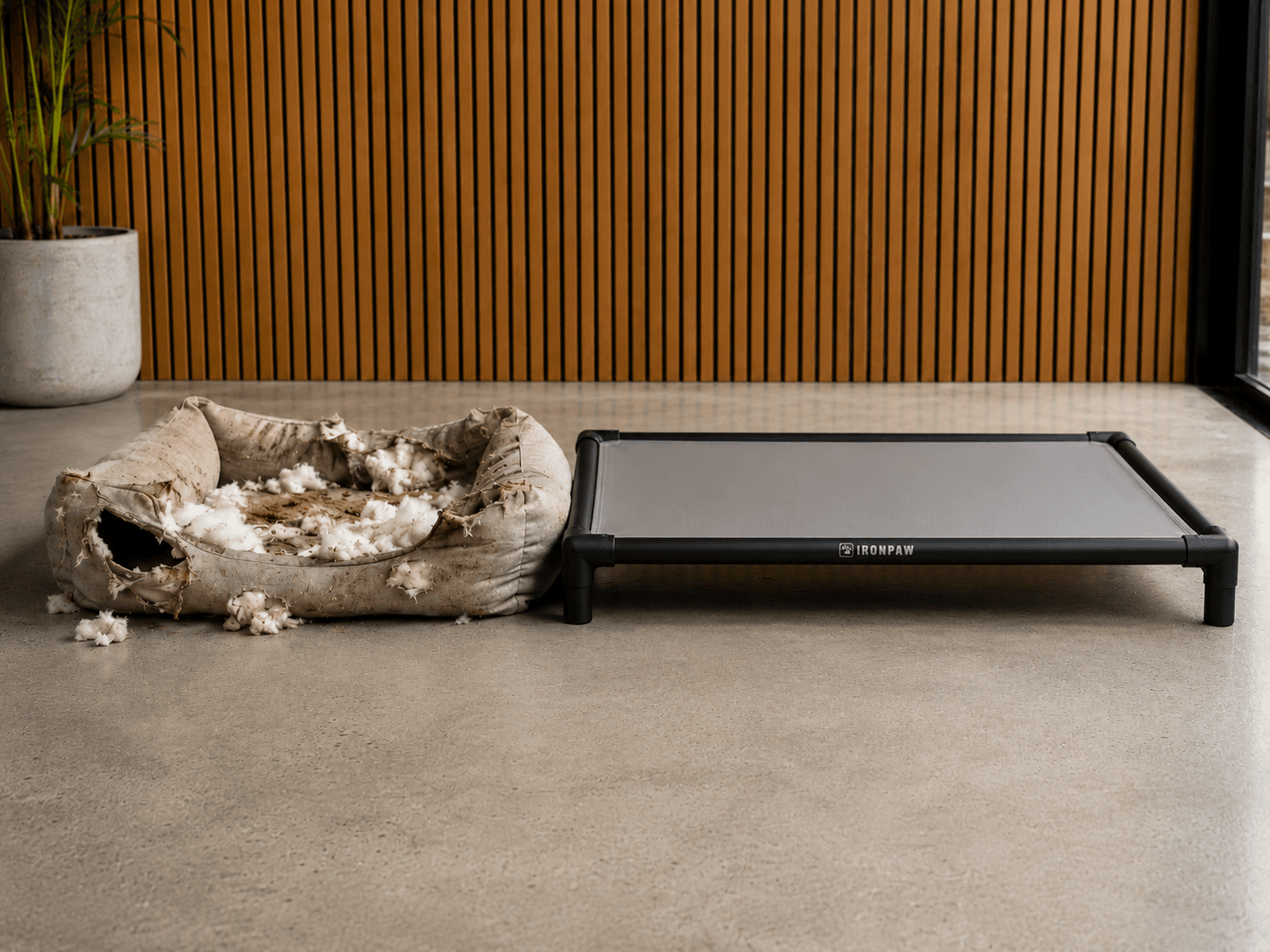
Yes — though not in the way that’s often marketed.
No bed is genuinely indestructible. A determined dog with enough motivation will eventually damage any material. But bed construction does affect how quickly destruction happens, whether it’s dangerous when it does, and whether the dog is even motivated to start.
Foam and fibre-filled beds have several properties that make them attractive targets: they’re soft like prey, they have stuffing that rewards the effort of breaking through, and they typically have stitched seams and zip closures that give a dog a starting point.
Elevated PVC fabric beds change this equation in a few ways. There’s no stuffing to reward the effort. The surface is firm rather than soft, which is less satisfying to grip and tear. And a mechanically-clamped frame has no exposed stitching or zip to start working on.
For dogs with high jaw drive or breed-driven chewing instincts, this matters more than fabric weight alone. It’s not just about making the bed harder to destroy — it’s about making it less worth starting on in the first place.
The short version
If your dog keeps destroying their bed, the bed probably isn’t the problem. The behaviour is a signal — of boredom, anxiety, instinct, or discomfort. Finding which of those is driving it points you toward what will actually help.
Better management, more appropriate chew outlets, structured training, and — where anxiety is involved — professional support are all more effective long-term solutions than replacing the bed and hoping the next one lasts longer.
That said, once you’ve addressed the underlying cause, the type of bed you choose does matter. Removing the properties that make a bed an easy and rewarding target is a reasonable part of the solution — it just can’t be the whole of it.
Pingback: High-Drive Dog Exercise: Why A Walk Won’t Cut It - IronPaw